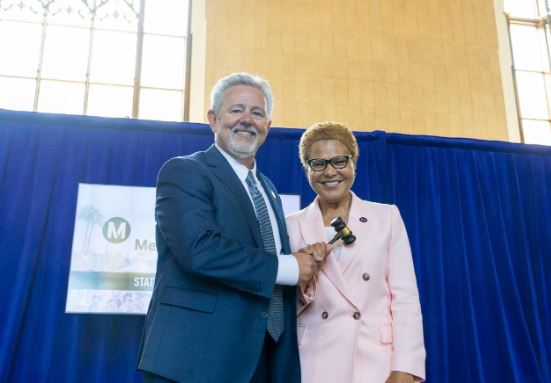
Los Angeles Mayor Karen Bass outlined safety, affordability, reliability and readiness for the 2028 Olympic and Paralympic Games as her four priorities after taking over as chair of the LA Metro Board.
In her State of the Agency address, Bass said Los Angeles is no longer solely a car-dependent region. LA Metro operates the nation’s second-largest public transit system behind New York, recording more than 300 million bus and rail boardings during the past year—nearly one million rides per day. Bus services account for approximately 700,000 daily boardings.
Under her “Metro Safe” priority, Bass highlighted the transit agency’s developing public safety department. The new model will combine traditional law enforcement with social services and crisis-intervention professionals to address homelessness, substance abuse and mental health concerns across the system.
To make transit more affordable, Bass called for an expansion of the LIFE reduced-fare program and the development of a long-term financial strategy to eventually make Metro fare-free.
The existing GoPass program allows K-12 and community college students across Los Angeles County to ride Metro at no cost. The countywide MOBILITY Wallet program provides 2,000 participants with $1,800 that can be used for public transit, rideshare or bikeshare services.
Bass also pledged to improve the reliability of bus and rail services. Metro adjusted schedules on more than 100 bus routes in June and currently operates 80 miles of peak-hour bus lanes. She wants that network expanded to more than 100 miles by 2028.
Preparing for the 2028 Olympic and Paralympic Games will be another major focus. Bass said Metro’s performance during the recent World Cup demonstrated its ability to manage large crowds, with approximately 45,000 fans traveling safely through the system.
The mayor also highlighted ongoing transportation projects, including the A Line extension into the San Gabriel Valley, the first phase of the D Line extension and the proposed Sepulveda Transit Corridor connecting the San Fernando Valley with the Westside. The D Line is eventually expected to reach UCLA, which will serve as the Olympic Village in 2028.
Despite a difficult fiscal year, Bass said all Metro services remain fully funded. The agency has also invested more than $300 million in cleaning buses, rail cars and stations seven days a week.
“Metro Safe. Metro Affordable. Metro Reliable. And Metro Ready. That is our north star,” Bass said.